
Parent PLUS Loan Forgiveness Application: Your Complete 2025 Guide to Getting Relief
Are you a parent drowning in student loan debt for your child’s education? You’re not alone. Over 3.6 million families have Parent PLUS loans totaling more than $104 billion. The good news? Parent PLUS loan forgiveness IS possible – if you know the right steps to take.
Parent PLUS loans can feel like a financial blessing when your child heads off to college — but they can also become a heavy burden. With rising Parent PLUS loan interest rates and families juggling multiple expenses, many parents wonder:
- Can my Parent PLUS loan be forgiven?
- What is the Parent PLUS loan forgiveness application process?
- What if I can’t pay my Parent PLUS loan?
The good news: There are options for Parent PLUS loan forgiveness in 2025. But the rules are a little different than student loan forgiveness for your child. Whether you’re a young parent just starting this journey or a senior citizen nearing retirement with overwhelming debt, this guide will walk you through every option available to get relief from your Parent PLUS loans.
🏫 What is a Parent PLUS Loan?
A Parent PLUS loan is a federal student loan that parents take out to help pay for their child’s college education. Unlike other student loans, these loans have some unique characteristics:
- No borrowing limits (for loans before July 1, 2026)
- Higher interest rates than other federal student loans
- Credit check required (but standards are lenient)
- Parent is 100% responsible for repayment
- Cannot be transferred to the student
Current Parent PLUS loan interest rate: 9.08% (as of 2024-2025)
Key points about Parent PLUS loans:
- You apply through the FAFSA Parent PLUS loan application.
- The loan is in your name, not your child’s.
- Current Parent PLUS loan interest rate (2025): around 8%+ — one of the highest among federal loans.
- They don’t come with income-driven repayment plans by default (but you can access them with a workaround).
That’s why understanding the Parent PLUS loan forgiveness application is so important — it’s one of the few ways to get relief.
Important Change Coming: New Limits Starting July 2026
Starting July 1, 2026, Parent PLUS borrowing is capped at $20,000 per year and $65,000 total per dependent student. This change significantly affects forgiveness options for future borrowers.
Parent PLUS Loan Forgiveness: What Options Do You Have?
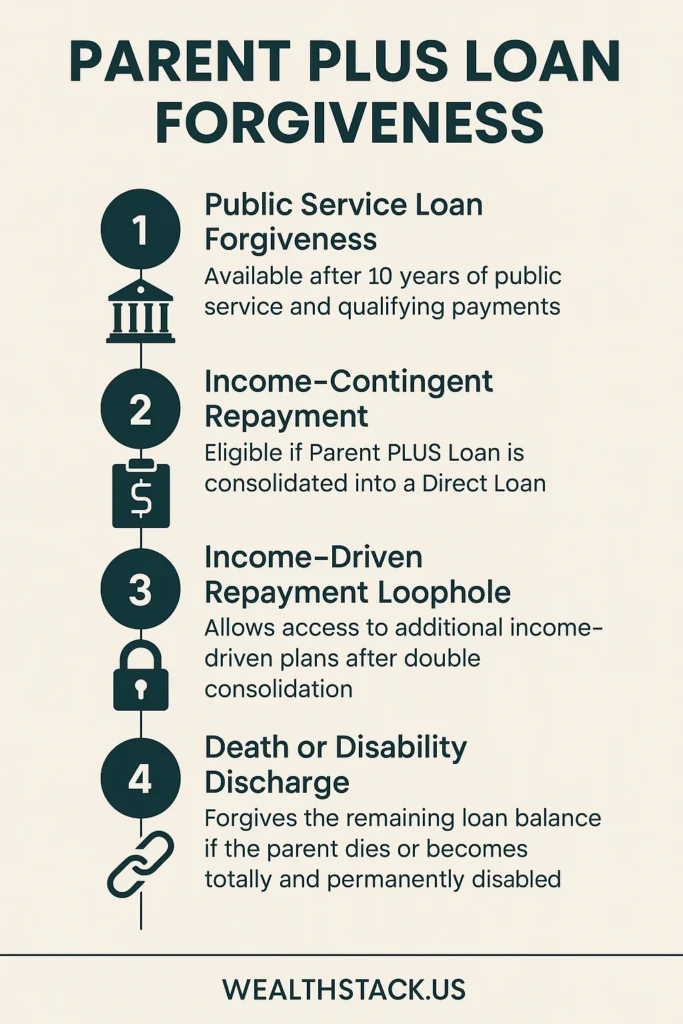
The truth about Parent PLUS loan forgiveness might surprise you. While options are more limited than regular student loans, several paths to relief exist:
- Income-Contingent Repayment (ICR) Forgiveness
- Public Service Loan Forgiveness (PSLF)
- Loan Discharge Programs
- Death Discharge
- Disability Discharge
Let’s break down each option in simple terms.
The ICR Path: Your Primary Route to Parent PLUS Loan Forgiveness
Here’s the key strategy most parents don’t know about:
Parent PLUS loans aren’t directly eligible for income-driven repayment. The only way in is to consolidate into a Direct Consolidation Loan and then choose the Income-Contingent Repayment (ICR) plan.
How ICR Forgiveness Works (Step-by-Step)
Step 1: Consolidate Your Loans
- Apply for Direct Consolidation at StudentAid.gov
- Combine all your Parent PLUS loans into one new loan
- Deadline Alert: Must consolidate before July 1, 2026
Step 2: Choose ICR Repayment
- Select Income-Contingent Repayment plan
- Deadline Alert: Must enter ICR before July 1, 2028
- Payments based on 20% of discretionary income
Step 3: Make Payments for 25 Years
- Make 300 qualifying payments
- Any remaining balance is forgiven
- Tax Alert: Forgiveness is tax-free through December 2025
Real Example: How Much Could You Save?
Meet Sarah, a 50-year-old teacher:
- Parent PLUS loan balance: $80,000
- Annual income: $45,000
- ICR payment: ~$200/month (instead of $800 standard payment)
- After 25 years: $60,000+ could be forgiven
Public Service Loan Forgiveness (PSLF): The 10-Year Solution
If you work for a qualifying employer, you could get forgiveness in just 10 years instead of 25.
Who Qualifies for PSLF?
- Government employees (federal, state, local)
- Non-profit workers (501(c)(3) organizations)
- Teachers in public schools
- Military personnel (active duty or civilian employees)
- Healthcare workers at qualifying hospitals
- Social workers at government agencies
The PSLF Process for Parent PLUS Loans
- Consolidate your Parent PLUS loans (before July 1, 2026)
- Choose ICR repayment plan (before July 1, 2028)
- Work full-time at qualifying employer
- Make 120 payments (10 years)
- Apply for forgiveness after 120th payment
Important: For Parent PLUS disbursed on or after July 1, 2026: These loans are not eligible for ICR or RAP. They can only use the standard plan.
Infographic: Parent PLUS Loan Forgiveness Timeline
Before July 1, 2026 Loans:
┌─────────────────┐    ┌─────────────────┐    ┌─────────────────┐
│   Consolidate   │ →  │   Choose ICR    │ →  │  Make Payments  │
│  Parent PLUS    │    │   Repayment     │    │   120 (PSLF)    │
│     Loans       │    │     Plan        │    │   300 (ICR)     │
└─────────────────┘    └─────────────────┘    └─────────────────┘
                                                       ↓
                                              ┌─────────────────┐
                                              │    FORGIVEN!    │
                                              │  (Tax-free thru │
                                              │   Dec 2025)     │
                                              └─────────────────┘

After July 1, 2026 Loans:
┌─────────────────┐    ┌─────────────────┐    ┌─────────────────┐
│  Limited to     │ →  │ Standard Plan   │ →  │   No Special    │
│ $20K/year max   │    │     Only        │    │   Forgiveness   │
└─────────────────┘    └─────────────────┘    └─────────────────┘
Loan Discharge Programs: When Life Happens
Sometimes forgiveness comes through unfortunate circumstances. Here are automatic discharge options:
Death Discharge
- Parent dies: Loan is completely forgiven
- Student dies: Loan is completely forgiven
- No tax consequences for family
- Automatic process – family just needs to provide death certificate
Total and Permanent Disability Discharge
- Parent becomes disabled: Loan can be discharged
- Must prove inability to work
- Three-year monitoring period required
- Student’s disability doesn’t qualify for Parent PLUS discharge
Other Discharge Options
- Bankruptcy (extremely rare and difficult)
- School closure while student was enrolled
- False certification by the school
- Identity theft discharge
- Unpaid refund from school
Parent PLUS Loan Forgiveness Application: Step-by-Step Process
For ICR Forgiveness:
Step 1: Gather Your Information
- Social Security number
- FSA ID (create at StudentAid.gov)
- Tax returns (last 2 years)
- Loan servicer information
Step 2: Apply for Direct Consolidation
- Visit StudentAid.gov
- Complete consolidation application
- Choose “Income-Contingent Repayment” plan
- Submit within deadlines
Step 3: Annual Requirements
- Recertify income yearly
- Update family size changes
- Keep employment records (if pursuing PSLF)
For PSLF Application:
Step 1: Submit Employment Certification
- Complete PSLF form annually
- Get employer signature
- Submit to loan servicer
- Track qualifying payments
Step 2: Apply for Forgiveness
- After 120th payment
- Complete PSLF application
- Provide employment verification
- Wait for approval (typically 90 days)
What Happens If You Can’t Pay Your Parent PLUS Loan?
Don’t panic – you have options:
Immediate Relief Options:
- Deferment (temporary pause for specific reasons)
- Forbearance (temporary pause for financial hardship)
- Income-driven repayment (through consolidation)
Long-term Solutions:
- Consolidation and ICR (as described above)
- Refinancing with private lender (lose federal protections)
- Payment assistance programs (employer, state, military)
What NOT to Do:
- ❌ Ignore the problem (leads to default)
- ❌ Skip payments without communication
- ❌ Assume there’s no help available
The Parent PLUS Loan “Loophole” Explained
Financial experts often refer to the “Parent PLUS loophole” – here’s what it means:
The Strategy:
- Consolidate Parent PLUS loans
- Choose ICR repayment
- If income is low enough, monthly payment could be $0
- Still get credit toward 25-year forgiveness
- Interest may capitalize, but eventual forgiveness covers it
Who Benefits Most:
- Parents with low income relative to loan balance
- Parents nearing retirement
- Single parents or those with large families
Regional and Demographic Considerations
For Young Parents (Ages 25-35):
- Focus on: PSLF if you qualify (faster forgiveness)
- Consider: Career choices that qualify for public service
- Plan ahead: 25-year commitment for ICR forgiveness
For Middle-Aged Parents (Ages 36-55):
- Evaluate: Current career vs. PSLF-eligible positions
- Consider: ICR payments vs. standard payments
- Factor in: Other children’s college costs
For Senior Parents (Ages 55+):
- Prioritize: ICR for lower monthly payments
- Consider: Impact on retirement planning
- Remember: Forgiveness may occur during retirement years
For Low-Income Families:
- Take advantage: $0 payments under ICR if income qualifies
- Combine with: Other need-based aid programs
- Document carefully: All income and family size changes
Parent PLUS Loan Forgiveness Biden Administration Updates
Recent policy changes have created both opportunities and deadlines:
Positive Changes:
- Tax-free forgiveness extended through December 2025
- Simplified PSLF process with temporary expansions
- Fresh Start program for defaulted borrowers
Important Deadlines:
- July 1, 2026: Last chance to consolidate for ICR eligibility
- July 1, 2028: Last chance to enter ICR repayment
- December 31, 2025: Tax-free forgiveness expires (unless extended)
Are Parent PLUS Loans Forgiven After 10 Years?
Short answer: Only through PSLF.
Here’s the breakdown:
- Regular Parent PLUS loans: Not forgiven after 10 years
- With PSLF: Forgiven after 120 payments (10 years) if you qualify
- With ICR: Forgiven after 300 payments (25 years)
FAFSA Parent PLUS Loan: How to Apply
Annual FAFSA Process:
- Complete FAFSA by school’s deadline
- Review Student Aid Report (SAR)
- Apply for Parent PLUS if needed
- Complete credit check (soft inquiry initially)
- Sign Master Promissory Note
Tips for FAFSA Success:
- Submit early (October 1st each year)
- Use IRS Data Retrieval Tool
- Update if financial circumstances change
- Communicate with financial aid office
Alternative Strategies and Employer Programs
Employer Student Loan Assistance:
Many companies now offer student loan repayment benefits:
- Average benefit: $100-$300 monthly
- Tax treatment: Up to $5,250 annually tax-free through 2025
- May cover: Parent PLUS loans (check with HR)
State-Specific Programs:
Several states offer loan repayment assistance:
- Healthcare professionals: Many states offer programs
- Teachers: State-specific forgiveness programs
- Legal professionals: Some states help lawyers in public service
Military Benefits:
- Active duty: Some loan repayment programs
- Reserves/National Guard: Student loan repayment programs
- VA employees: PSLF-eligible positions
Creating Your Parent PLUS Loan Forgiveness Action Plan
Step 1: Assess Your Situation
- [ ] Calculate total Parent PLUS debt
- [ ] Review current interest rates
- [ ] Determine current monthly payments
- [ ] Assess family income and size
Step 2: Choose Your Path
- [ ] PSLF (if you qualify for public service work)
- [ ] ICR forgiveness (25-year plan)
- [ ] Combination approach
- [ ] Alternative strategies
Step 3: Take Action Before Deadlines
- [ ] Consolidate loans (if pursuing ICR/PSLF)
- [ ] Submit employment certification (if pursuing PSLF)
- [ ] Set up income recertification reminders
- [ ] Document all payments and employment
Step 4: Monitor and Adjust
- [ ] Annual income recertification
- [ ] Track qualifying payments
- [ ] Stay informed about policy changes
- [ ] Consider tax implications of forgiveness
Financial Planning for Different Life Stages
College Students (Ages 16-22):
Even though you’re not taking out Parent PLUS loans, understanding them helps you:
- Appreciate your parents’ sacrifice
- Make informed decisions about college costs
- Plan for your own future as a potential parent
Young Parents (Ages 25-35):
- Start planning for forgiveness early
- Consider career paths that qualify for PSLF
- Budget for long-term payment commitments
- Explore employer assistance programs
Established Parents (Ages 36-50):
- Evaluate switching to public service careers
- Balance Parent PLUS payments with retirement saving
- Consider impact on multiple children’s education costs
- Explore refinancing if forgiveness isn’t viable
Pre-Retirement Parents (Ages 51-65):
- Prioritize lower monthly payments through ICR
- Plan for potential tax bomb from forgiveness
- Consider impact on Social Security benefits
- Evaluate early retirement vs. continued payments
Senior Citizens (Ages 65+):
- Understand Social Security garnishment rules
- Consider disability discharge if applicable
- Plan for estate implications
- Seek assistance programs for seniors
Common Mistakes to Avoid
❌ Waiting Too Long to Act
- Deadlines for consolidation and ICR are firm
- Missing deadlines eliminates forgiveness options
- Early action preserves more choices
❌ Not Understanding Tax Implications
- Forgiveness may be taxable income
- Plan for potential “tax bomb” in 25 years
- Current tax-free period ends December 2025
❌ Assuming Private Refinancing is Always Better
- Lose federal protections and forgiveness options
- Can’t switch back to federal programs
- May not save money long-term
❌ Not Tracking Payments Properly
- PSLF requires exact payment tracking
- Missing documentation can delay forgiveness
- Annual employment certification is crucial
Frequently Asked Questions
What is Parent PLUS Loan Forgiveness?
Parent PLUS loan forgiveness enables eligible loans to be forgiven under certain federal programs, providing relief for parents financing their children’s education.
How do Income-Driven Repayment Plans Work for Parent PLUS Loans?
Parent PLUS loans, once consolidated into a Direct Consolidation Loan, can be repaid under an Income-Contingent Repayment plan, which bases payments on income levels.
When is the Deadline for Parent PLUS Borrowers to Act?
Deadlines for applying for loan forgiveness programs, like the PSLF Waiver, can vary. Financial advisors should continuously check NerdWallet’s guide for updates on deadlines to best assist clients.
What are the Eligibility Criteria for Parent PLUS Forgiveness?
Eligibility often requires consolidation into a Direct Consolidation Loan and fulfilling specific criteria, such as employment in public service roles for PSLF.
How Can Parent PLUS Borrowers Lower Their Payments?
Advisors can assist in lowering payments by recommending consolidation, opting for income-driven plans, and potentially refinancing, dependent on clients’ financial conditions.
Will Parent PLUS loans be eligible for forgiveness?
Yes, but with limitations. Parent PLUS loans disbursed before July 1, 2026, can qualify for ICR forgiveness after consolidation. After that date, new loans have very limited forgiveness options.
What happens if I can’t pay my Parent PLUS loan?
You have several options including deferment, forbearance, consolidation into ICR for lower payments, or employer assistance programs. The worst thing you can do is ignore the problem.
What is the loophole for Parent PLUS loans?
The “loophole” refers to consolidating Parent PLUS loans and choosing ICR, which can result in $0 monthly payments for low-income borrowers while still counting toward 25-year forgiveness.
Are Parent PLUS loans forgiven at death?
Yes, Parent PLUS loans are discharged if either the parent borrower or the student for whom the loan was taken dies. This discharge has no tax consequences for survivors.
Your Next Steps: Taking Action Today
If you have Parent PLUS loans disbursed before July 1, 2026:
- Apply for consolidation immediately if pursuing forgiveness
- Choose ICR repayment plan before the July 2028 deadline
- Submit PSLF employment certification if applicable
- Set calendar reminders for annual requirements
If you’re considering future Parent PLUS loans:
- Understand the new limitations starting July 2026
- Explore alternative funding options first
- Consider the long-term financial impact on your family
- Plan for standard repayment without special forgiveness options
Conclusion: Hope and Help Are Available
Parent PLUS loan forgiveness may seem complicated, but with the right knowledge and action plan, relief is possible. Whether you’re pursuing the 25-year ICR path or the 10-year PSLF route, the key is understanding your options and acting before important deadlines.
Remember:
- Time is critical – key deadlines are approaching
- Multiple paths exist for different situations
- Professional help is available if you need guidance
- You’re not alone in this financial challenge
The most important step is the first one. Don’t let overwhelming debt define your family’s future when forgiveness options are still available. Take action today to secure a better financial tomorrow for you and your family.
🧾 Step-by-Step: Parent PLUS Loan Forgiveness Application
Here’s how to actually apply:
- Check eligibility – PSLF, ICR, Borrower Defense, or discharge.
- Consolidate your loans at studentaid.gov if required.
- Enroll in the right repayment plan (ICR for PSLF or long-term forgiveness).
- Submit employment certification (for PSLF).
- Apply for forgiveness after completing requirements.
👉 Always keep detailed records of payments, employment, and correspondence.
💡 Financial Advisor’s Tip
- If you work in public service → PSLF may be your best path.
- If not → Consolidation + ICR may help you manage payments until forgiveness.
- If struggling → Explore deferment, forbearance, or refinancing (though refinancing removes federal protections).
Remember: Parent PLUS loans have higher interest rates than most federal loans. Managing them wisely can save your family thousands.
🏁 Final Thoughts
The Parent PLUS loan forgiveness application isn’t as simple as it should be, but relief is possible. Whether through PSLF, ICR, Borrower Defense, or discharge, you have options.
Don’t ignore these loans — create a plan. As a parent, you took on debt to help your child succeed. Now, it’s time to protect your financial future too.
Need personalized help with your Parent PLUS loan situation? Consider consulting with a financial advisor who specializes in student loan planning. Many offer free consultations and can help you navigate the complex rules and deadlines to maximize your forgiveness potential.
References
- Home Warranty Mold Coverage 2025: What’s Covered and What’s Not
- Gas vs Electric Hot Water Heater 2025
- The Best 529 Plan Alternatives for Smarter College Savings
- The DoorDash Impact on Retirement Savings: Is DoorDash Eating Into Your Retirement?
- How to Use 529 Plans for Non-College Education
- Artificially Feeling Poor – A Wealth Mindset for Financial Growth in 2025

Riley Morgan is a personal finance writer and wealth strategist with over a decade of experience covering budgeting, credit optimization, banking products, and investment fundamentals for everyday Americans.
Riley’s work focuses on translating complex financial concepts into clear, actionable guidance — helping readers at every income level make smarter decisions about their money. Articles published on WealthStack.us draw on primary research, direct product testing, and data sourced from authoritative institutions including the IRS, Federal Reserve, CFPB, and SEC.
Riley is not a licensed financial advisor, CPA, or CFP. All content on WealthStack.us is for informational and educational purposes only and does not constitute personalized financial, tax, or investment advice. Readers should consult a qualified financial professional before making any financial decisions.
Connect: https://www.linkedin.com/in/riley-morgan-us | Questions or corrections: rileymorgan.us@gmail.com
1 thought on “Parent PLUS Loan Forgiveness Application: The Complete 2025 Guide”