
🎓 How to Use 529 Plans for Non-College Education?
529 plans are famous for helping families save money for college. But here’s the big surprise: you don’t have to go to college to benefit from a 529 plan. Thanks to new laws, these education savings accounts can now help pay for many non-college learning paths too.
Think your 529 plan is only good for college? Think again! Whether you’re a parent planning for your child’s future, a student exploring career options, or someone looking to learn new skills, 529 plans have expanded far beyond traditional four-year colleges. Let’s explore how you can maximize these tax-advantaged savings accounts for various educational paths.
Let’s break it down in simple terms and show you creative ways to use 529 plans, what to do if your child doesn’t go to college, and how you can make the most of your 529 dollars.
What Are 529 Plans and Why Should You Care?
A 529 plan is like a special savings account designed for education expenses. The money you put in grows tax-free, and when you take it out for qualified education expenses, you don’t pay taxes on the earnings. It’s essentially free money from the government to help with education costs!
The Big News: Recent changes in laws (like the SECURE Act) have dramatically expanded what you can use 529 funds for. This means more opportunities and flexibility for your educational investments.
🧾 List of Qualified 529 Expenses (Non-College Edition)
Here are some qualified expenses that 529 plans can now cover:
| Expense Type | Covered by 529 Plan? ✅ |
|---|---|
| Trade school tuition | ✅ Yes |
| Apprenticeship program fees | ✅ Yes (if registered) |
| Certification exams | ✅ Yes |
| Textbooks, tools, equipment | ✅ Yes |
| Room & board (if enrolled half-time) | ✅ Yes |
| Online education (accredited) | ✅ Yes |
1. Trade Schools and Vocational Training
What qualifies: Plumbing, electrical work, automotive repair, cosmetology, culinary arts, and hundreds of other skilled trades.
Why it matters: Trade school graduates often earn excellent salaries with less debt than college graduates. According to recent data, many skilled trades offer starting salaries of $40,000-$60,000+ per year.
How 529 plans help:
- Cover tuition and fees
- Pay for required tools and equipment
- Fund room and board (if applicable)
- No taxes on withdrawals for qualified expenses
2. Professional Certifications and Licenses
What’s covered:
- Real estate licenses
- Insurance certifications
- IT certifications (CompTIA, Cisco, Microsoft)
- Healthcare certifications (CNA, pharmacy tech)
- Project management certifications (PMP)
Real-world example: Sarah used her 529 plan to pay for her real estate license course ($500) and exam fees ($200). She’s now earning $75,000 annually as a realtor.
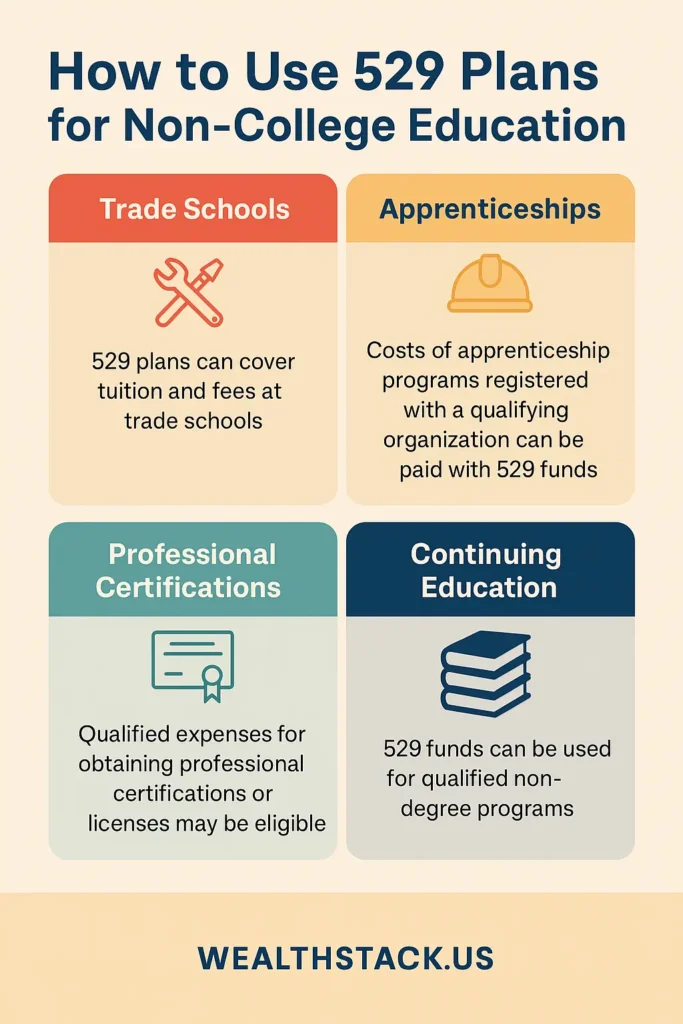
3. Apprenticeship Programs
What qualifies: Registered apprenticeships through organizations like:
- Labor unions
- Employer associations
- Government agencies
Popular apprenticeships that qualify:
- Electrician programs
- Carpentry training
- HVAC technician programs
- Medical assistant programs
4. Online Education and Continuing Education
How to use 529 plans for non-college education online:
- Accredited online trade schools
- Professional development courses
- Certification programs from recognized institutions
- Language learning programs (if from qualifying schools)
Creative Ways to Use 529 Plans
For Students (Ages 12-18):
- Dual enrollment courses in high school
- Summer programs at qualifying institutions
- Test prep courses from accredited providers
- Early career exploration through vocational programs
For Young Adults (Ages 18-30):
- Career pivoting through certification programs
- Skill upgrading in your current field
- Entrepreneurship training through accredited programs
- International study programs at qualifying schools
For Mid-Career Professionals (Ages 30-50):
- Professional development certifications
- Industry-specific training programs
- Leadership development courses
- Technology skills training
For Senior Citizens (50+):
- Lifelong learning at community colleges
- Hobby-related courses at accredited institutions
- Health and wellness programs
- Arts and crafts training at qualifying schools
What Happens to 529 if Child Does Not Go to College?
Don’t panic! You have several excellent options:
Option 1: Transfer to Another Family Member
- Siblings, cousins, parents, or even yourself
- No penalties for qualified transfers
- Keeps the tax advantages intact
Option 2: Use for Alternative Education
- Trade schools
- Professional certifications
- Apprenticeships
- Online learning programs
Option 3: Save for Future Use
- Money can stay in the account indefinitely
- Continue growing tax-free
- Use for grandchildren’s education
Option 4: Recent Game-Changer (2024 Rules)
- Roll over up to $35,000 to a Roth IRA
- Must meet specific conditions
- Provides retirement savings option
Why Some Say “529 Plans Are a Bad Idea” (And Why They’re Usually Wrong)
Common Concerns:
- “Limited investment options” – While true, most plans offer diverse portfolios
- “High fees” – Many states offer low-cost options
- “Penalties for non-education use” – Only on earnings, and there are many education options now
The Reality:
- Tax benefits far outweigh limitations for most families
- Expanded qualified expenses offer more flexibility
- State tax deductions provide additional benefits
How to Open a 529 Plan : Step-by-Step Guide
Step 1: Research Your Options
- Check your state’s plan first (potential tax benefits)
- Compare fees and investment options
- Look at performance history
Step 2: Choose Your Plan Type
- Direct-sold plans: Lower fees, self-managed
- Advisor-sold plans: Professional guidance, higher fees
Step 3: Gather Required Information
- Social Security numbers
- Bank account information
- Beneficiary details
Step 4: Complete the Application
- Online applications take 10-15 minutes
- Choose investment options
- Set up automatic contributions
Step 5: Fund Your Account
- Initial minimum varies by state ($25-$250 typically)
- Set up automatic monthly contributions
- Consider gift contributions from family
Maximizing Your 529 Plan Strategy
For Young Families:
- Start early, even with small amounts
- Use automatic contributions
- Take advantage of state tax deductions
- Consider gifts from grandparents
For Older Students:
- Focus on shorter-term, lower-risk investments
- Research all qualified options before deciding on college
- Don’t forget about summer programs and continuing education
For Career Changers:
- Use 529 funds for retraining programs
- Consider online options for flexibility
- Look into employer partnerships with educational institutions
Real-World Success Stories
Mike’s Story: Used his 529 plan for HVAC certification ($3,500). Now earns $65,000 annually with excellent job security.
Jennifer’s Journey: Transferred unused college funds to pay for her daughter’s cosmetology school ($12,000). Daughter now owns a successful salon.
David’s Decision: Used 529 funds for IT certifications ($2,800). Increased his salary by $25,000 within two years.
Common Mistakes to Avoid
- Not researching school eligibility – Always verify schools are on the Department of Education’s list
- Forgetting about state tax benefits – Many states offer deductions for contributions
- Waiting too long to start – Time is your biggest advantage in saving
- Not considering all family members – Plans can benefit multiple generations
- Overlooking non-traditional paths – Trade schools and certifications often provide excellent ROI
Planning for 2025 and Beyond
New rules and expansions are constantly being considered. Stay informed about:
- Additional qualified expenses being added
- Changes to contribution limits
- New rollover options
- State-specific benefit updates
Getting Help: When to Consult a Financial Advisor
Consider professional help if you:
- Have multiple children with different educational goals
- Want to coordinate 529 plans with other savings strategies
- Need help with complex family situations
- Have significant assets requiring tax planning
Your Next Steps
- Assess your situation: What are your educational goals or your family’s goals?
- Research options: Look into your state’s 529 plan benefits
- Start small: Even $25-50 per month can make a significant difference over time
- Stay informed: Educational rules and opportunities continue to expand
- Take action: The best time to start was yesterday; the second-best time is today
Final Thoughts: Your Educational Future is Flexible
The modern world offers countless paths to success, and 529 plans have evolved to support this reality. Whether you’re heading to Harvard or to HVAC school, whether you’re 16 or 60, these tax-advantaged accounts can help you achieve your educational and career goals. Download How to use 529 plans for non college education pdf
Remember: Education is an investment in yourself or your family that pays dividends for a lifetime. With 529 plans now covering everything from traditional college to trade schools to professional certifications, you have more options than ever to build the future you want.
Ready to get started? Research your state’s 529 plan today, and take the first step toward tax-free educational savings. Your future self will thank you for making this smart financial move today. Read more
This article provides general information about 529 plans and should not be considered personalized financial advice. Always consult with qualified financial professionals and verify current regulations before making investment decisions.
References
- Understanding Fed Rate Cuts 2025 and Their Impact on Financial Strategies
- The Complete Guide to the Ink Business Cash Credit Card: Everything You Need to Know
- The Best 529 Plan Alternatives for Smarter College Savings
- The DoorDash Impact on Retirement Savings: Is DoorDash Eating Into Your Retirement?
- Mortgage Rates today
- Mastering the Art of Disputing a Medical Bill

Riley Morgan is a personal finance writer and wealth strategist with over a decade of experience covering budgeting, credit optimization, banking products, and investment fundamentals for everyday Americans.
Riley’s work focuses on translating complex financial concepts into clear, actionable guidance — helping readers at every income level make smarter decisions about their money. Articles published on WealthStack.us draw on primary research, direct product testing, and data sourced from authoritative institutions including the IRS, Federal Reserve, CFPB, and SEC.
Riley is not a licensed financial advisor, CPA, or CFP. All content on WealthStack.us is for informational and educational purposes only and does not constitute personalized financial, tax, or investment advice. Readers should consult a qualified financial professional before making any financial decisions.
Connect: https://www.linkedin.com/in/riley-morgan-us | Questions or corrections: rileymorgan.us@gmail.com