
💡 Artificially Feeling Poor – A Wealth Mindset for Financial Growth
How a simple mindset shift can transform your financial future? Have you ever wondered why some people with average incomes become millionaires while others with high salaries struggle financially? The secret often lies in their money mindset.
What if one of the most powerful ways to grow rich… is to feel poor?
Sounds strange, right? But it’s a strategy used by many financially successful people — and it’s called artificially feeling poor. By choosing to live with a scarcity mindset (even if you earn well), you can unlock smarter money habits, boost savings, and reach financial freedom faster.
In this guide, we’ll break down this concept in plain English, show you how to apply it, and explain why this “wealth mindset” might be your best investment. Let’s explore a counterintuitive wealth-building strategy that has helped countless Americans build substantial wealth: artificially feeling poor.
🤔 What Does “Artificially Feeling Poor” Mean?
It means you act like you have less money than you actually do. Artificially feeling poor means intentionally creating a mindset of financial scarcity, even when you have money in the bank. It’s about tricking your brain into believing money is tight so you naturally make smarter financial decisions. You simulate being poor so that you:
- Spend less
- Save more
- Stay focused on your financial goals
This mindset has roots in one key principle:
“Living on the financial edge makes you focus.”
Think of it this way: when you genuinely feel broke, you become incredibly careful with every dollar. You compare prices, avoid impulse purchases, and find creative ways to save money. This mindset becomes a powerful tool for building wealth when applied strategically.
💸 The Problem with Feeling “Rich”
When you feel like you have plenty of money, you:
- Eat out more
- Upgrade your gadgets often
- Take unplanned vacations
- Forget about your long-term goals
This is why abundance breeds complacency. Feeling rich today can sabotage your future. But feeling poor today — even if it’s artificial — keeps you financially sharp and disciplined.
Why Living on the Financial Edge Makes You Focus?
The Psychology Behind Scarcity
When we feel financially comfortable, our brains often go into “spending mode.” Psychologists call this the “abundance effect” – when people perceive they have plenty of resources, they become less careful about how they use them.
Money mindset examples of this include:
- Ordering expensive coffee daily because “I can afford it”
- Buying name-brand items without checking prices
- Skipping coupon hunting or sale shopping
- Making impulse purchases on credit cards
However, living on the financial edge makes you focus on what truly matters. Every spending decision becomes intentional, leading to better financial outcomes.
The 7 Steps to Developing a Wealthy Mindset
Here’s your practical roadmap to building The Wealth Mindset through artificial scarcity:
Step 1: Set Artificial Income Limits
Pretend you earn 70-80% of your actual income. Direct the remaining 20-30% straight into savings and investments before you can touch it.
Real-world example: If you earn $5,000 monthly, live as if you only make $4,000. Automatically save or invest that extra $1,000.
Step 2: Create “Broke” Rules
Establish spending rules as if you’re financially tight:
- No purchases over $50 without a 48-hour waiting period
- Always check for discounts before buying
- Use the “need vs. want” test for every purchase
Step 3: Track Every Dollar
When you feel poor, every dollar matters. Use apps like Mint, YNAB, or even a simple notebook to track where your money goes.
Step 4: Build Your Emergency Fund Like Your Life Depends on It
A Solution to Getting Rich Is to Feel Poor because it forces you to prioritize emergency savings. Aim for 6-12 months of expenses before any luxury spending.
Step 5: Automate Your “Poverty”
Set up automatic transfers to savings and investment accounts immediately after payday. Make it impossible to spend money you’ve designated for wealth building.
Step 6: Find Free and Low-Cost Entertainment
Embrace activities that don’t cost much:
- Public parks and hiking trails
- Library events and free classes
- Home cooking instead of dining out
- Free community events and festivals
Step 7: Celebrate Small Wins
Acknowledge when you successfully resist spending or hit savings milestones. This reinforces your positive money mindset.
💼 How Financial Advisors Use This Strategy
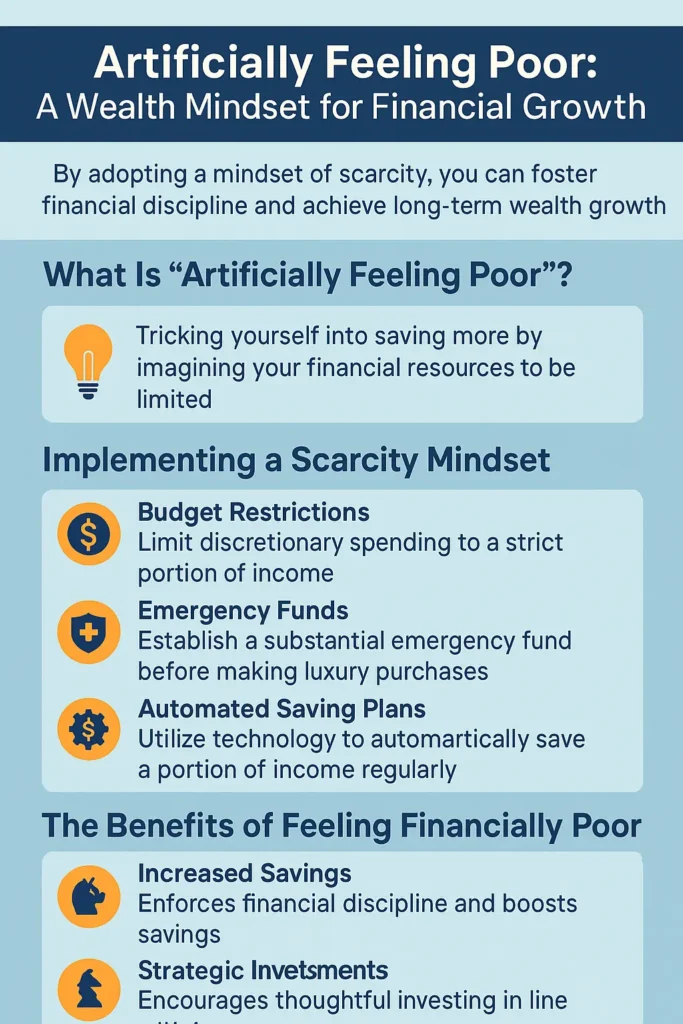
As a financial advisor, I often help clients simulate scarcity to build long-term security.
Here’s how we apply it:
- 📊 Set strict discretionary budgets (e.g., only 10% of income on non-essentials)
- 💰 Prioritize emergency funds before luxury spending
- 🤖 Use automation to “hide” money in investments before it’s spent
- 📉 Model two futures: one with conservative spending and one without
- 🧠 Coach clients on psychology — because mindset drives money behavior
The goal is not to make clients feel deprived. It’s to help them focus, discipline, and build real freedom.
📈 Smart Saving & Investing Tips for a Scarcity Mindset
💵 Save First, Then Spend
Use the “reverse budget” method: save before paying bills or spending on fun.
🔁 Increase Savings With Income
Each time you get a raise or bonus, increase your savings rate by 50% of that bump.
🧠 Automate Frugal Thinking
Use apps that simulate lower bank balances (some budgeting tools do this).
📊 Diversify Wisely
Even if you feel financially “tight,” continue to invest consistently across stocks, bonds, real estate, and retirement accounts.
Money Mindset Examples in Action
For Students (Ages 12-18)
- Treat your allowance or part-time job income as if it’s 20% less
- Always comparison shop for school supplies and clothes
- Save half of any gift money before spending the rest
For Young Adults (Ages 19-30)
- Live in a slightly cheaper apartment than you can afford
- Cook at home instead of eating out frequently
- Buy used cars instead of financing new ones
- Start investing even if it’s just $25 per month
For Middle-Aged Adults (Ages 31-55)
- Avoid lifestyle inflation with every raise or promotion
- Question every subscription service monthly
- Take vacations using points, deals, and off-season pricing
- Max out retirement contributions before luxury spending
For Senior Citizens (55+)
- Continue living below your means even in retirement
- Be strategic about when and how you withdraw from retirement accounts
- Look for senior discounts on everything
- Consider downsizing to reduce expenses
Developing a Positive Money Mindset: The Complete Framework
Shift Your Language
Instead of saying “I can’t afford it,” say “I choose not to spend money on that right now.” This maintains your sense of control while reinforcing good financial habits.
Reframe Saving as Paying Yourself First
Think of your savings and investments as bills that must be paid. You’re paying your future self before anyone else gets your money.
Focus on Net Worth, Not Income
A positive money mindset measures success by what you keep and grow, not just what you earn. Someone earning $50,000 who saves $10,000 is building more wealth than someone earning $100,000 who saves nothing.
Common Mistakes to Avoid
Don’t Create Real Financial Stress
This strategy should feel challenging but not create genuine anxiety. If artificially feeling poor causes real stress about basic needs, you’ve gone too far.
Balance is Key
Allow yourself some enjoyable spending within your artificial budget. Complete deprivation often leads to financial “binge spending” later.
Don’t Ignore Long-term Goals
While feeling artificially poor, still invest in your future through education, health, and career development.
The Science Behind Why This Works
Behavioral Economics Principles
Research shows that people make better financial decisions when they perceive resources as limited. This is called “scarcity mindset” and, when applied correctly to finances, leads to:
- More careful evaluation of purchases
- Increased focus on value and quality
- Greater appreciation for what you have
- Stronger motivation to find additional income sources
The Compound Effect
Small, consistent financial decisions compound over time. By artificially feeling poor and saving an extra $200 monthly, you could have over $100,000 more after 20 years (assuming 7% annual returns).
Technology Tools to Support Your Wealth Mindset
Budgeting Apps
- Mint: Free comprehensive budgeting
- YNAB: Zero-based budgeting system
- PocketGuard: Prevents overspending
Automatic Saving Tools
- Qapital: Rounds up purchases and saves the change
- Acorns: Invests your spare change automatically
- Digit: Uses AI to save money based on your spending patterns
Investment Platforms for Beginners
- Robinhood: Commission-free stock trading
- Betterment: Automated investing with low fees
- Vanguard: Low-cost index funds and ETFs
Real Success Stories
Sarah, Age 25, Teacher
“I started living on 75% of my teaching salary and automatically invested the rest. Five years later, I had enough for a house down payment while my friends were still living paycheck to paycheck.”
Mike, Age 45, Marketing Manager
“After getting a promotion, I kept living like I was still making my old salary. The ‘extra’ income went straight to investments. Now I’m on track to retire 10 years early.”
Betty, Age 68, Retiree
“Even in retirement, I maintain my ‘artificially poor’ mindset. It’s helped my savings last longer and given me peace of mind about money.”
Your Next Steps: Implementing The Wealth Mindset Today
Week 1: Assessment
- Calculate your true monthly income after taxes
- List all current expenses
- Identify areas where you could reduce spending
Week 2: Set Up Systems
- Open a high-yield savings account for your “poor person” budget
- Set up automatic transfers to savings/investments
- Install budgeting apps
Week 3: Practice Artificial Scarcity
- Live on 80% of your income for one week
- Track every purchase and ask “Is this necessary?”
- Find free alternatives to paid activities
Week 4: Refine and Commit
- Adjust your artificial income based on what felt comfortable
- Set up long-term investment accounts
- Create accountability systems
The Long-Term Vision: Building Generational Wealth
Artificially feeling poor isn’t about permanent deprivation—it’s about delayed gratification for financial freedom. People who master this mindset often discover they can:
- Retire earlier than planned
- Handle financial emergencies without stress
- Take calculated risks like starting businesses
- Leave money to their children and grandchildren
- Contribute meaningfully to causes they care about
Frequently Asked Questions
How does feeling poor help in growing wealth?
Feeling artificially poor creates the discipline needed for consistent saving and smart spending. It prevents lifestyle inflation and keeps you focused on building wealth instead of showing it off.
What if I feel deprived using this method?
Remember, this is artificial scarcity with a purpose. Allow yourself planned splurges within your budget. The goal is smarter spending, not no spending.
How long should I maintain this mindset?
Many wealthy individuals maintain some version of this mindset permanently. It becomes a habit that protects them from overspending regardless of their net worth.
Can this strategy work for low-income families?
Yes, but modify it carefully. Even saving $25 monthly can build wealth over time. Focus more on smart spending than aggressive saving if money is genuinely tight.
What’s the difference between being cheap and artificially feeling poor?
Being cheap focuses on spending as little as possible regardless of value. Artificially feeling poor focuses on spending intentionally while prioritizing long-term wealth building.
Your Journey to Financial Freedom Starts with Your Mindset
The path to wealth doesn’t always require a high income or lucky breaks. Sometimes, the most powerful tool is simply changing how you think about money. By artificially feeling poor, you’re training your brain to make decisions that wealthy people make naturally.
Remember, every millionaire started somewhere. Many of them used this exact strategy, living below their means even as their incomes grew. The earlier you start, the more dramatic your results will be.
Your positive money mindset journey begins today. Start small, be consistent, and watch as your “artificially poor” strategy transforms into real, lasting wealth.
🏁 Final Thoughts: Think Poor to Grow Rich
“A solution to getting rich is to feel poor — on purpose.”
By artificially feeling poor, you build financial muscles that last a lifetime. You:
- Save more
- Spend less
- Invest smarter
- Stay focused
- Reduce stress
It’s not about self-deprivation. It’s about long-term freedom.
So whether you’re 17 or 70, this mindset shift can completely change your financial future.
Ready to transform your financial future? Start implementing these wealth mindset strategies today, and remember—the best time to plant a tree was 20 years ago. The second-best time is now.
References
- Understanding Fed Rate Cuts 2025 and Their Impact on Financial Strategies
- The Complete Guide to the Ink Business Cash Credit Card: Everything You Need to Know
- The Best 529 Plan Alternatives for Smarter College Savings
- The DoorDash Impact on Retirement Savings: Is DoorDash Eating Into Your Retirement?
- How to Use 529 Plans for Non-College Education
- Mastering the Art of Disputing a Medical Bill
1 thought on “Artificially Feeling Poor – A Wealth Mindset for Financial Growth in 2025”