
Introduction — Standard Deduction vs. Itemized Deductions
Which saves you more money: taking the standard deduction or itemizing your deductions? For investors, entrepreneurs, students, and retirees alike, the right choice can materially improve after-tax returns. Here’s a clear, advisor-level guide—augmented with tech workflows—to help you decide with confidence.
The Core Decision: Standard Deduction, Itemized Deductions, and How to Reduce Taxable Income
Let’s define the two paths:
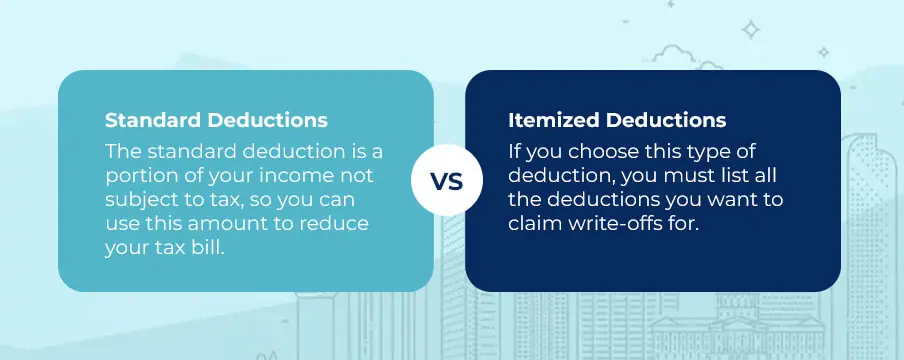
- Standard deduction: A flat, no-questions-asked reduction to your taxable income based on your filing status (single, married filing jointly, etc.). It’s simple, fast, and often the best choice for taxpayers with modest deductible expenses.
- Itemized deductions: You list specific deductible expenses—like mortgage interest, state and local taxes (SALT, subject to limits), charitable gifts, and medical expenses above a threshold. Itemizing requires documentation but can exceed the standard deduction if your expenses are high enough.
Advisor quick test: You generally choose whichever yields the larger reduction to taxable income. If your legitimate itemized deductions add up to more than your standard deduction, itemize; otherwise, take the standard deduction.
What about above-the-line deductions? These reduce your Adjusted Gross Income (AGI) and are available whether you itemize or not. Examples include contributions to Health Savings Accounts (HSAs), some retirement contributions, student loan interest (subject to income limits), and certain educator expenses. Strategically, above-the-line deductions can help you:
- Lower AGI to qualify for other credits or deductions
- Reduce modified AGI for IRA/Roth contribution eligibility and Medicare IRMAA considerations
- Lower the taxable portion of Social Security for retirees
Tech-forward framing: Your advisor and tax software can run scenarios to compare standard vs. itemized deductions, test above-the-line strategies, and quantify after-tax ROI. This is where automation pays—fast iteration, fewer missed deductions, and more dollars compounding for you.
Real-life examples by life stage:
- Student/early career: You likely rent, take the standard deduction, and focus on above-the-line deductions (HSA if eligible, traditional IRA contributions) and credits (AOTC/LLC for education).
- Mid-career professional/homeowner: Mortgage interest, SALT (within limits), and charitable contributions may push you into itemizing, especially in high-tax states or with large gifts.
- Retiree: If the mortgage is paid off, itemizing may be less compelling. But bunching charitable giving (via donor-advised funds) or using Qualified Charitable Distributions (QCDs) from IRAs can outperform the standard deduction depending on your situation.
Regulatory note on amounts:
- The IRS adjusts the standard deduction annually for inflation and typically announces next-year figures each November. For accurate 2025 and 2026 standard deduction figures, confirm directly with the IRS or reliable tax publishers before filing. Use tax software or your advisor’s planning tools for the most current numbers.
Strategy Playbook: Tax Deductions, Tax Advice, and When to Use Tax Software (or the Best Tax Software)
Your goal: reduce taxable income while aligning with your financial plan. Here’s the advisor workflow I use—blending human judgment with AI-enabled tools.
- Baseline your return
- Pull last year’s return and current-year YTD data (pay stubs, brokerage reports, 1098 mortgage interest, YTD charitable receipts).
- Use secure aggregators (or your advisor’s client portal) to consolidate data flows automatically.
- Run a “standard deduction vs. itemized deductions” simulation in tax software to establish your baseline.
- Optimize above-the-line deductions first
- HSA contributions (if you’re in a qualifying high-deductible health plan) often deliver triple tax benefits: deductible contributions, tax-deferred growth, tax-free withdrawals for qualified medical expenses.
- Traditional IRA or 401(k) contributions reduce current-year taxable income (subject to limits and plan rules).
- Self-employed? Leverage SEP IRA, Solo 401(k), and deductible health insurance premiums.
- Student loan interest (if eligible) is an above-the-line deduction that reduces AGI.
- Evaluate itemized categories
- Mortgage interest: Particularly impactful early in the amortization schedule.
- State and local taxes: SALT deduction is subject to annual caps—check current law.
- Charitable contributions: Cash gifts and appreciated securities have different rules; gifting appreciated shares can eliminate capital gains and preserve cash.
- Medical expenses: Eligible only above a percentage of AGI—significant only in high-expense years.
- Miscellaneous deductions: Largely limited under current law—verify what’s allowed this year.
- Use “bunching” to beat the standard deduction
- Charitable bunching: Consolidate multiple years of giving into one tax year to exceed the standard deduction in that year, then take the standard deduction the next year(s). A donor-advised fund (DAF) is the most seamless tool here.
- Medical expense timing: Where possible, schedule procedures or pay large medical bills in the same year to clear the AGI threshold for deduction.
- Portfolio-aware tax moves
- Donate appreciated securities instead of cash to maximize impact and avoid capital gains.
- Tax-loss harvesting: Realize losses to offset gains, but coordinate with wash-sale rules.
- Qualified Charitable Distributions (QCDs) from IRAs (age 70½+): Reduce taxable IRA distributions and can count toward RMDs, a powerful tool even if you take the standard deduction because QCDs are excluded from income rather than itemized.
- Automate documentation and audit resilience
- Use AI receipt capture (bank feeds + OCR) to tag donations, property taxes, and medical payments in real time.
- Maintain a digital “deduction locker”: year-round document storage with automated reminders for missing forms.
- Advisors: Layer a rules engine that flags discrepancies (e.g., property tax spikes, missing 1098) for pre-filing review.
- Decide: standard or itemized?
- Re-run scenarios in tax software with updated year-end data.
- Confirm your break-even. If itemized deductions exceed the standard deduction, itemize. If not, take the standard deduction and focus on above-the-line tactics for AGI reduction.
- Monitor 2025 and 2026 standard deduction updates
- The 2025 standard deduction will be announced by the IRS ahead of filing season. Do not rely on old figures. Good tax software updates automatically; verify in-app.
Advisor tip on “the best tax software”:
- Look for programs with:
- Robust scenario modeling (standard vs. itemized, Roth conversions, DAF/QCD strategies)
- API connections to custodians and payroll data
- AI-powered document classification
- Accurate treatment of state returns and SALT limitations
- Transparent version control and yearly tax law updates
- If you’re a DIY filer with a straightforward return, mainstream consumer tax software can be sufficient. For complex returns (business ownership, K-1s, multi-state filings, large charitable strategies), consider an advisor or CPA using professional-grade software plus a client portal for secure collaboration.
The Advisor’s Matrix: When Standard Deduction Wins vs. When Itemizing Wins
Use this quick matrix to guide your expectation before running the numbers:
- Standard deduction most likely wins if:
- You rent or have minimal mortgage interest
- You live in a low-tax state or have limited SALT
- Your charitable giving is spread out in small increments across years
- Medical expenses are modest versus AGI
- You prefer simplicity and your time is valuable (time ROI matters)
- Itemized deductions often win if:
- You have a new or large mortgage (high interest paid)
- You pay high state income and property taxes (subject to caps)
- You bunch charitable giving, donate appreciated securities, or fund a DAF
- You have extraordinary medical expenses or casualty losses
- You’re in a high-bracket year and deductions meaningfully reduce your marginal tax
Portfolio management overlay:
- High-bracket investors should evaluate whether itemizing plus charitable planning can defend against bracket creep, NIIT exposure, and higher Medicare IRMAA.
- Roth conversion planning: Lower-AGI years may favor conversions; higher-AGI years may favor deduction stacking. Run both through tax software to compare lifetime after-tax wealth.
2025 Standard Deduction and 2026 Standard Deduction: How to Plan Before IRS Numbers Post
- Timing: The IRS typically releases next-year inflation adjustments in Q4. For 2025 and 2026, bookmark the IRS news page and confirm figures before filing.
- Planning without exact numbers:
- Use conservative estimates in projections.
- Build ranges: If your itemized deductions are comfortably above last year’s standard deduction plus expected inflation, you’ll likely itemize again.
- If you’re near the break-even, favor flexibility—delay or accelerate deductible expenses (charitable timing, property tax payments where allowed, elective medical) to cross the threshold.
- Advisor workflow: We run sensitivity analyses scenario A (you itemize) vs. scenario B (you take the standard deduction), then sequence moves like DAF contributions, QCDs, and capital gains realization to target optimal after-tax outcomes.
Capitalist lens: The goal isn’t to “win” on deductions—it’s to maximize after-tax free cash flow and reinvest the savings at attractive risk-adjusted returns. Every dollar you don’t send to the IRS—legally and ethically—is capital you can deploy for compounding.
Practical Walkthroughs by Life Stage and Complexity
- Student and early-career professional
- Likely path: Standard deduction, plus above-the-line tactics.
- Actions:
- Contribute to Roth IRA if in a low bracket; otherwise traditional IRA if deduction is valuable.
- If HSA-eligible, fund it first (powerful long-term compounding for healthcare).
- Track education credits; don’t overpay by skipping them in software.
- Use basic tax software; turn on AI document import to avoid data-entry errors.
- Dual-income homeowners in high-tax states
- Likely path: Itemize if mortgage interest and SALT (up to current cap) plus charitable gifts exceed the standard deduction.
- Actions:
- Bunch charitable giving via a DAF in high-income years.
- Donate appreciated equities; replace the position if you still want exposure to reset basis.
- Consider timing of property tax payments (subject to local rules).
- Coordinate with equity comp events (RSUs/NSOs/ISOs) to manage AMT/ordinary income impacts.
- Entrepreneur or self-employed professional
- Likely path: Either can win; focus on above-the-line and business deductions first.
- Actions:
- Max out SEP IRA or Solo 401(k), and consider profit-sharing.
- Deduct eligible health insurance premiums.
- Track home office and vehicle expenses accurately (use mileage-tracking apps and AI receipt categorization).
- Then assess itemized vs. standard.
- Use professional-grade software or a CPA if you receive K-1s.
- Retiree with RMDs and sizable charitable intent
- Likely path: Mix QCDs and standard deduction; itemize only when it clearly wins.
- Actions:
- Use QCDs to reduce AGI directly—valuable for managing Social Security taxation and Medicare IRMAA.
- Charitable bunching via DAF is still useful if QCDs don’t cover all giving.
- Coordinate with partial Roth conversions in low-income years; run multi-year projections.
Technology Edge: AI, Automation, and Advisor Workflows
- Data collection: Connect payroll, banking, and brokerage feeds; use AI to detect deductible transactions (property taxes coded correctly, charitable receipts matched to bank entries).
- Scenario modeling: Tax engines simulate standard vs. itemized outcomes, Roth conversions, and DAF/QCD strategies at the click of a button.
- Error prevention: Anomaly detection flags missing 1098s or inconsistent SALT entries compared to last year.
- Collaboration: Secure client portals streamline document exchange and e-signatures; advisors can co-browse tax software with clients for real-time decisions.
- Investment alignment: Tax-aware rebalancing tools coordinate with your deduction strategy—e.g., harvesting losses in a year you itemize large charitable gifts to keep AGI in target ranges.
Common Itemized Deductions to Track (and How to Document with Automation)
- Mortgage interest: Download 1098 directly from lender portal; auto-store in your deduction locker.
- SALT (subject to current caps): Pull property tax receipts via county portal; cross-check with escrow statements.
- Charitable contributions:
- Cash: Keep bank/credit card records and written acknowledgments.
- Appreciated assets: Brokerage confirmations plus charity receipts showing no goods/services received.
- Medical expenses: EOBs from insurers, pharmacy expense exports, and provider receipts.
- Casualty/theft losses and disaster-area deductions: Follow IRS guidance and keep all insurance settlement documentation.
Pro tip: If your annual itemized deductions hover just below the standard deduction, build a “deduction calendar” to intentionally bunch every 2–3 years. Many families can lift after-tax cash flow significantly with this rhythm.
Measuring ROI: Time, Money, and Audit Readiness
- Time ROI: If itemizing adds several hours of work for a marginal benefit, consider the standard deduction and redirect time to higher-value planning (e.g., investment strategy, estate planning).
- Money ROI: If itemizing produces a noticeable tax delta—especially at high marginal rates—take it and systematize documentation with tech so it’s painless next year.
- Audit readiness: Organized records lower stress and speed resolution. Automation and consistent categorization build confidence.
Subtle but Powerful: Credits vs. Deductions
- Deductions reduce taxable income; credits reduce tax owed dollar-for-dollar.
- Sometimes the optimal plan is a standard deduction plus heavy focus on credits (education, energy-efficient home improvements, child-related credits), which may be more valuable than forcing itemization.
Case Study Snapshots
- The high-earner gifter: A married couple in a high-tax state, new mortgage, and a plan to give $50k over five years. We front-load $50k into a DAF this year using appreciated ETFs. Result: Itemized deductions far exceed the standard deduction this year, gain avoidance on donated shares, and the DAF spreads grants to charities over the next five years while the couple takes the standard deduction in off-years.
- The retiree optimizer: A 72-year-old with RMDs and annual giving of $8k. We switch all giving to QCDs from the IRA. Even while taking the standard deduction, taxable income drops versus writing checks, improving IRMAA prospects and net after-tax income.
- The entrepreneur’s blend: A consultant uses a Solo 401(k) with profit-sharing to reduce AGI, then sees that itemized deductions barely beat the standard deduction. We bunch property tax (where allowed) and shift a $10k gift to this year to push clearly into itemizing territory, maximizing savings.
FAQ Section
Q: What is the difference between standard deduction and itemized deductions?
A: The standard deduction is a fixed amount that reduces taxable income based on your filing status—simple and documentation-light. Itemized deductions require listing eligible expenses (mortgage interest, SALT up to limits, charitable gifts, certain medical costs). You choose whichever produces the larger deduction.
Q: When should I itemize my deductions?
A: Itemize when the total of your allowable itemized expenses exceeds your standard deduction. Common triggers include high mortgage interest, substantial charitable gifts (especially via bunching or donating appreciated assets), significant SALT payments (subject to caps), or large medical expenses that clear the AGI threshold.
Q: Can I take the standard deduction if I have deductions to itemize?
A: Yes. You may always choose the standard deduction instead of itemizing. The optimal choice is purely mathematical—take the option that lowers your tax bill the most. If your itemized total is lower than the standard deduction, take the standard deduction and focus on above-the-line deductions to reduce AGI.
Q: How do tax software programs help with deductions?
A: Quality tax software imports financial data, tests standard vs. itemized automatically, and runs multi-scenario analyses (charitable bunching, QCDs, Roth conversions). AI features categorize receipts and flag missing forms. This reduces errors, speeds filing, and helps you capture every deduction you earn.
Q: What expenses can be itemized for a tax deduction?
A: Common categories include mortgage interest (Form 1098), state and local taxes (within caps), charitable contributions (cash and property, with documentation rules), medical and dental expenses above an AGI threshold, and certain casualty or disaster losses. Confirm current-year eligibility and limits before filing.
Q: How do I know if I will save more money by itemizing?
A: Add up your eligible itemized expenses and compare them to your standard deduction for your filing status. Most tax software will do this instantly. If itemized exceeds standard, itemize. If not, take the standard deduction. If you’re close, consider bunching strategies (DAF contributions, timing property taxes, scheduling medical payments) to push over the threshold.
Conclusion
The smartest move in the standard deduction vs. itemized deductions decision is to blend timeless tax strategy with modern technology. Use above-the-line deductions to lower AGI, model itemized vs. standard outcomes in tax software, and time your giving or expenses to beat the threshold when it pays. Whether you’re an 18-year-old building your first Roth, a peak-earning professional optimizing after-tax returns, or a retiree engineering tax-efficient income and charitable impact, the capitalistic edge comes from clarity, calculation, and execution. Adopt a tech-enabled workflow now—so more of your capital compounds for you, not the IRS.
Ready to systematize your tax strategy? Connect your accounts, run your 2025–2026 scenarios in trusted tax software, and build a deduction calendar today.
References
- Investopedia — Standard Deduction: https://www.investopedia.com/terms/s/standarddeduction.asp
- NerdWallet — Standard Deduction vs. Itemizing Deductions: https://www.nerdwallet.com/taxes/learn/itemized-deductions-standard-deduction
- Delta Vacations: A Financial Advisor’s Guide to ROI, Status, and Smarter Travel Spend
- 529 Plan for Continuing Education: Tax-Smart Funding for Credentials, Courses, and Career
- 2026 Income Tax Brackets: What Changes, Who Wins, and How to Act Now
- Capital Gains Tax Brackets 2025 2026: Rates, Planning, and Pro-Level Tactics
- Training Repayment Agreement Provisions (TRAPs): What Investors and Workers Need to Know
1 thought on “Standard Deduction vs. Itemized Deductions: A Practical, Data‑Driven Guide for 2025–2026”