


If you’re expecting a tax refund 2026, you’re not alone. The IRS reports that the average federal tax refund hovers around $3,000 — a meaningful lump sum that deserves a smarter home than a checking account paying you next to nothing. But here’s the challenge: interest rates are falling. The Federal Reserve has been cutting rates, and the high-yield savings accounts that once offered 5%+ APY are slowly drifting lower.
Table of Contents
That doesn’t mean you’re out of options. It means you need a strategy.
This guide walks you through the best places to park your tax refund in 2026, how to compare your options in a falling-rate environment, and how to build a cash strategy that works whether rates keep dropping or level off. Let’s make your refund work harder than you do.
Why Your Tax Refund 2026 Deserves a Real Strategy
Most people deposit their refund, feel good for a week, and then watch it slowly disappear into everyday expenses. That’s a missed opportunity — especially when you’re sitting on $2,000 to $5,000 or more.
Think about it this way: $3,000 parked in a high-yield savings account at 4.5% APY earns roughly $135 over 12 months. That same $3,000 in a standard checking account earning 0.01% earns about 30 cents. The difference is real money, and it compounds over time.
The goal isn’t to swing for the fences with risky investments. The goal is to understand where to put tax refund 2026 dollars so they grow steadily, stay accessible when you need them, and don’t get eaten alive by inflation.
Understanding the Falling-Rate Environment in 2026
Before you choose where to park your cash, you need to understand the financial landscape you’re operating in.
The Federal Reserve began cutting rates in late 2024, and by 2026, the federal funds rate has settled into a lower range than the peaks seen in 2023. According to Federal Reserve economic data via FRED, rate-cutting cycles typically last 12 to 24 months, which means the window for locking in today’s rates may be narrowing.
Here’s what falling rates mean for your savings options:
- High-yield savings accounts (HYSAs): Rates drop relatively quickly as the Fed cuts, since most HYSAs are variable-rate products.
- Certificates of deposit (CDs): CD rates falling rate environment is a key concern — but CDs let you lock in a rate before it drops further.
- Treasury bills: Short-term T-bills reset at auction, so yields will decline over time, but they remain competitive for now.
- Money market funds: These track short-term rates closely and will drift lower alongside Fed cuts.
Understanding this environment helps you decide how much flexibility you want versus how much yield you’re willing to lock in. The trade-off between liquidity and return is the central tension of your tax refund strategy.
Best High Yield Savings Account 2026: What to Look For
A high-yield savings account remains one of the most popular — and sensible — places to park a tax refund. It’s liquid, FDIC-insured up to $250,000, and requires virtually no effort to open.
The best high yield savings account 2026 options come from online banks, credit unions, and fintech platforms. These institutions have lower overhead than traditional brick-and-mortar banks, which means they pass more of the yield on to you.
What to Compare When Choosing a HYSA
- APY (Annual Percentage Yield): The headline number. Look for accounts currently offering 4.0% to 4.8% APY in early 2026.
- Minimum balance requirements: Some accounts require $1,000 or more to earn the advertised rate.
- Withdrawal limits: Federal rules no longer cap savings withdrawals at six per month, but some banks still impose their own limits.
- FDIC or NCUA insurance: Non-negotiable. Make sure your deposits are protected.
- Mobile app and ease of transfer: If moving money in and out is painful, you won’t use the account effectively.
Top Picks for HYSAs in 2026
While specific rates change frequently, consistently strong performers include:
- Ally Bank: Known for no minimum balance and a solid mobile experience.
- Marcus by Goldman Sachs: Competitive APY with a clean, simple interface.
- SoFi: Offers higher rates for members who set up direct deposit.
- Discover Online Savings: Strong customer service and consistent rate competitiveness.
You can compare current rates at Bankrate’s savings account tracker, which updates daily.
Money Market Fund vs High Yield Savings 2026: Which Wins?
This is one of the most common questions people ask when deciding where to park cash. Both are low-risk, liquid options — but they work differently.
High-Yield Savings Accounts
- Insured: FDIC-backed up to $250,000.
- Rate type: Variable — moves with the Fed.
- Access: Instant transfers to linked checking accounts.
- Tax treatment: Interest is taxed as ordinary income.
Money Market Funds
- Insured: Not FDIC-insured, but considered very low risk. Invested in short-term, high-quality debt instruments.
- Rate type: Variable — also tracks short-term rates.
- Access: Typically same-day or next-day redemption.
- Tax treatment: Interest is taxed as ordinary income; some government money market funds offer state-tax-exempt income.
When comparing money market fund vs high yield savings 2026, the key differentiator is often the yield spread and your comfort with insurance. In a falling-rate environment, both will see yields decline at a similar pace. Government money market funds can offer a slight tax advantage if you’re in a high state-income-tax bracket.
Bottom line: If FDIC insurance matters most to you, stick with a HYSA. If you’re comfortable with the slightly different risk profile and want potential state-tax savings, a government money market fund is worth considering.
CD Rates Falling Rate Environment: Should You Lock In Now?
Certificates of deposit are a powerful tool in a falling-rate environment — if you time them right. When rates are dropping, locking in a CD today means you continue earning the higher rate even after the Fed cuts again.
Here’s the core logic: if a 12-month CD currently offers 4.5% APY and rates fall to 3.5% over the next year, you’ve captured an extra 1% on your principal. On a $3,000 refund, that’s an additional $30 — modest, but guaranteed.
CD Strategies for 2026
1. CD Laddering
Instead of putting all your refund into one CD, split it across multiple CDs with staggered maturities. For example:
- $1,000 into a 6-month CD
- $1,000 into a 12-month CD
- $1,000 into an 18-month CD
As each CD matures, you can reinvest at current rates or redirect the money elsewhere. This gives you both yield and liquidity.
2. No-Penalty CDs
Some banks offer CDs that allow early withdrawal without a fee. These are excellent in a falling-rate environment because you can exit if rates unexpectedly rise. The trade-off is a slightly lower APY than standard CDs.
3. Bump-Up CDs
A bump-up CD lets you request a rate increase once during the CD’s term if the bank raises its rates. Useful if you’re uncertain about rate direction.
What CD Rates Look Like in 2026
Based on current market conditions, 12-month CD rates from online banks range from approximately 4.0% to 4.6% APY. Compare options at NerdWallet’s CD rate comparison tool before committing.
Treasury Bills vs Savings Account 2026: The Safe Haven Showdown
For savers who want government-backed security and competitive yields, treasury bills are a compelling alternative. Understanding treasury bills vs savings account 2026 comes down to a few key differences.
What Are Treasury Bills?
Treasury bills (T-bills) are short-term U.S. government debt instruments with maturities ranging from 4 weeks to 52 weeks. You buy them at a discount and receive the full face value at maturity. The difference is your interest.
You can purchase T-bills directly through TreasuryDirect.gov with as little as $100.
T-Bills vs. High-Yield Savings Accounts
| Feature | Treasury Bills | High-Yield Savings |
|---|---|---|
| Backed by | U.S. Government | FDIC (up to $250K) |
| Rate type | Fixed at auction | Variable |
| State income tax | Exempt | Not exempt |
| Liquidity | Must hold to maturity or sell on secondary market | Withdraw anytime |
| Minimum investment | $100 | Varies ($0-$1,000) |
The state-tax exemption on T-bill interest is a meaningful advantage if you live in a high-tax state like California, New York, or New Jersey. For example, if you’re in the 9.3% California state income tax bracket, the effective yield on a T-bill is higher than the nominal rate suggests.
Tax Refund Investment Ideas 2026: Beyond Savings Accounts
If you’re financially stable — emergency fund in place, high-interest debt paid off — you might consider putting a portion of your tax refund into growth-oriented investments. Here are some tax refund investment ideas 2026 worth exploring.
1. Max Out Your Roth IRA
The 2026 Roth IRA contribution limit is $7,000 (or $8,000 if you’re 50 or older). If you haven’t maxed out your contribution for the year, your tax refund is a perfect source of funds. Roth IRA contributions grow tax-free, and qualified withdrawals in retirement are also tax-free.
This is arguably the highest-impact move you can make with a tax refund if you qualify based on income limits.
2. Invest in a Low-Cost Index Fund
If your Roth IRA is already maxed, consider a taxable brokerage account invested in a broad market index fund. Funds tracking the S&P 500 have historically returned an average of approximately 10% annually before inflation, according to data from Morningstar.
This is a long-term play — not appropriate for money you’ll need within 1 to 3 years.
3. Pay Down High-Interest Debt
This isn’t glamorous, but paying off credit card debt at 20%+ APR is a guaranteed 20% return. No investment can match that risk-adjusted return. If you carry high-interest debt, eliminating it with your refund is one of the smartest financial moves you can make.
4. Build or Top Up Your Emergency Fund
Financial advisors typically recommend 3 to 6 months of living expenses in an accessible, liquid account. If your emergency fund is underfunded, your tax refund is an ideal way to shore it up — especially in a high-yield savings account.
5. I Bonds (Series I Savings Bonds)
I Bonds are inflation-linked savings bonds issued by the U.S. Treasury. They’re designed to protect purchasing power. The annual purchase limit is $10,000 per person. In a period of lingering inflation, they can be a smart hedge, though they require a 12-month holding period before redemption.
How to Maximize Tax Refund Return: A Step-by-Step Framework
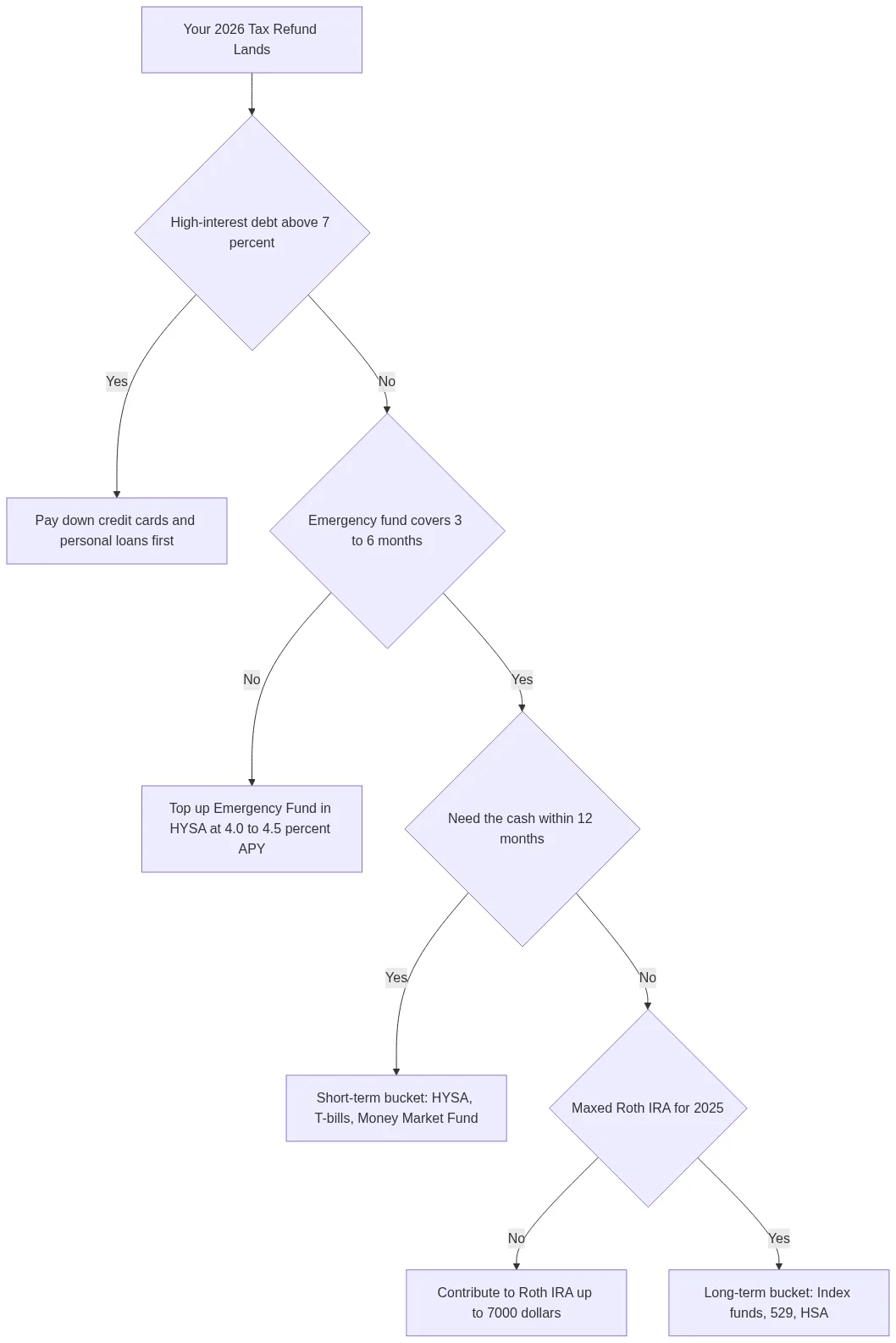
Knowing your options is one thing. Knowing how to prioritize them is another. Here’s a practical framework for how to maximize tax refund return based on your financial situation.
Step 1: Assess Your Financial Foundation
Before investing a dollar, answer these questions:
- Do you have at least 3 months of expenses saved in an emergency fund?
- Do you carry any high-interest debt (credit cards, personal loans above 8%)?
- Are you on track with retirement contributions?
Step 2: Eliminate High-Interest Debt First
If you carry credit card balances, pay them off before anything else. The guaranteed return of eliminating 20% APR debt beats any savings account or investment.
Step 3: Build Your Emergency Fund
Park 3 to 6 months of expenses in a best high yield savings account 2026 option. This is your financial safety net and should be liquid.
Step 4: Maximize Tax-Advantaged Accounts
Contribute to your Roth IRA or HSA (Health Savings Account) if eligible. These accounts offer tax benefits that amplify your returns over time.
Step 5: Optimize Your Cash Position
For money you’ll need within 1 to 3 years, use a combination of:
- High-yield savings accounts (for liquidity)
- CDs (for locked-in yield)
- T-bills (for state-tax efficiency)
Step 6: Invest for Long-Term Growth
Any remaining funds you won’t need for 5+ years can go into a diversified investment portfolio. Consider reading more about building a balanced investment portfolio to guide your allocation.
Best Place to Park Cash 2026: Quick-Reference Comparison
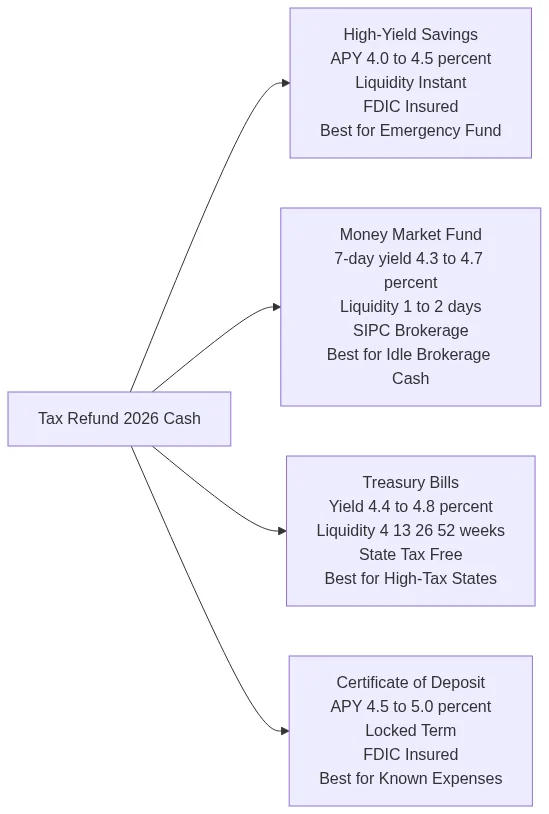
Here’s a side-by-side summary of the best place to park cash 2026, organized by time horizon and risk tolerance.
| Option | Best For | Approximate Yield (2026) | Liquidity | Risk |
|---|---|---|---|---|
| High-Yield Savings | Emergency fund, short-term | 4.0% – 4.8% APY | Instant | Very Low |
| Money Market Fund | Cash management, short-term | 4.0% – 4.6% APY | Same-day | Very Low |
| 12-Month CD | 1-year horizon, rate lock | 4.0% – 4.6% APY | Low (penalty) | Very Low |
| Treasury Bills | State-tax efficiency, 4-52 weeks | 4.0% – 4.5% | Moderate | None (govt-backed) |
| Roth IRA (Index Fund) | Retirement, 5+ years | Historically ~10% avg | Low | Moderate |
| I Bonds | Inflation hedge, 1+ year | CPI-linked | Low | Very Low |
Use this table as a quick-reference guide when deciding how to allocate your tax refund 2026 across different buckets.
Common Mistakes to Avoid With Your Tax Refund 2026

Even well-intentioned savers make costly errors. Here’s what to watch out for when managing your tax refund 2026 dollars.
- Letting it sit in a low-interest checking account: The opportunity cost is real. Even a few months in a HYSA beats zero.
- Chasing the highest rate without reading the fine print: Some accounts require direct deposit or minimum balances to earn the advertised rate.
- Putting it all in one place: Diversifying across a HYSA, CD, and T-bills gives you both yield and flexibility.
- Ignoring tax implications: Interest income is taxable. Keep records and account for it in your 2026 tax planning.
- Spending it impulsively: A tax refund feels like “found money,” but it’s your own money returned to you. Treat it with the same discipline as your paycheck.
Frequently Asked Questions
What is the best place to put my tax refund 2026?
The best place depends on your financial goals and time horizon. For most people, a high-yield savings account is the smartest first stop — it’s liquid, FDIC-insured, and offers significantly better returns than a standard checking account. From there, consider CDs for money you won’t need for 6 to 18 months, and T-bills for state-tax efficiency.
How do I choose between a money market fund and a high-yield savings account in 2026?
Both are solid options for short-term cash. The main differences are FDIC insurance (HYSAs have it; money market funds don’t) and potential state-tax savings (some money market funds invest in government securities that are state-tax exempt). If you live in a high-tax state and your balance exceeds $250,000, a money market fund may offer a tax advantage.
Are CD rates worth locking in during a falling-rate environment?
Yes — locking in today’s CD rates before further Fed cuts is a smart move for money you won’t need for 6 to 18 months. A CD ladder strategy lets you capture higher rates now while maintaining some liquidity as each CD matures.

Riley Morgan is a personal finance writer and wealth strategist with over a decade of experience covering budgeting, credit optimization, banking products, and investment fundamentals for everyday Americans.
Riley’s work focuses on translating complex financial concepts into clear, actionable guidance — helping readers at every income level make smarter decisions about their money. Articles published on WealthStack.us draw on primary research, direct product testing, and data sourced from authoritative institutions including the IRS, Federal Reserve, CFPB, and SEC.
Riley is not a licensed financial advisor, CPA, or CFP. All content on WealthStack.us is for informational and educational purposes only and does not constitute personalized financial, tax, or investment advice. Readers should consult a qualified financial professional before making any financial decisions.
Connect: https://www.linkedin.com/in/riley-morgan-us | Questions or corrections: rileymorgan.us@gmail.com