
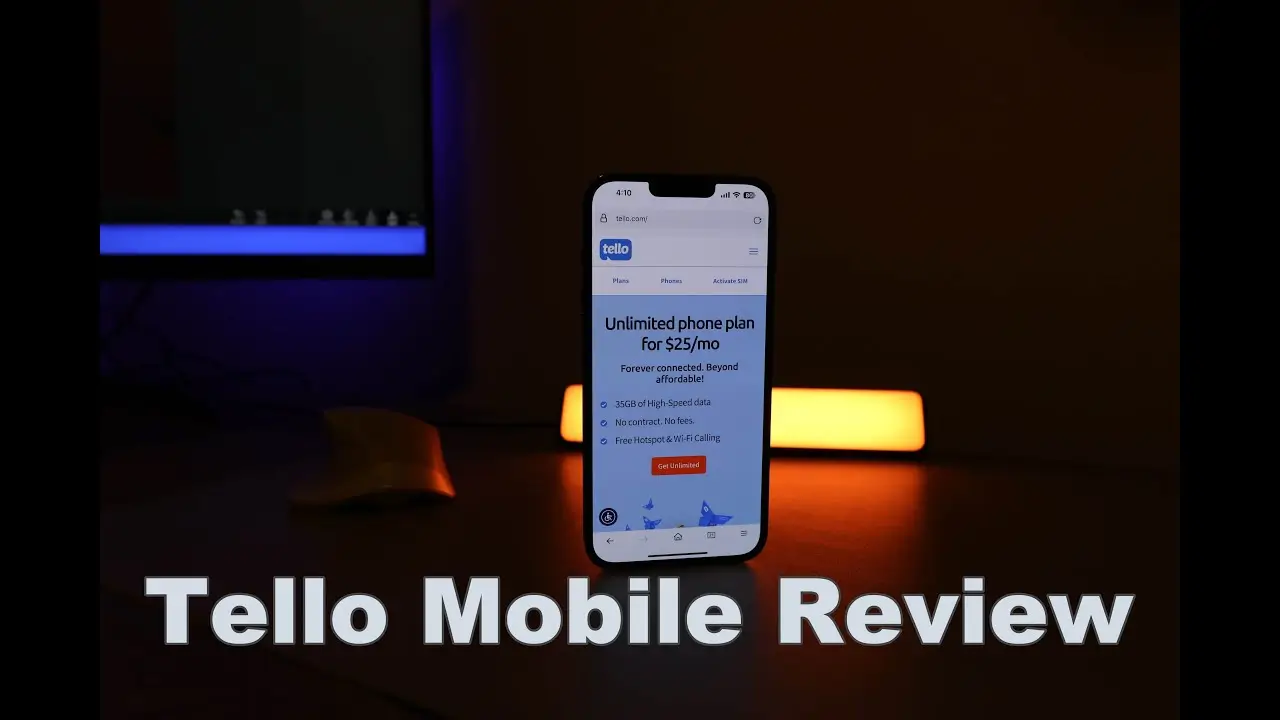
Tello Mobile Plan Review
If you manage money like an investor, your phone bill is a cash-flow lever. In this Tello Mobile Plan Review, I break down whether this budget MVNO’s flexible, no-contract plans can meaningfully increase your monthly surplus—and how reallocating those savings compounds into real wealth over time.
Tello review: What is Tello Mobile?
Tello is a budget mobile carrier (an MVNO) that runs on a major U.S. network’s infrastructure and passes savings to consumers through no contract mobile plans, build-your-own flexibility, and straightforward pricing. As a financial advisor who tracks recurring-expense ROI, I see Tello as a pure free‑market play: competition, transparency, and consumer choice.
- Ownership model: Tello is an MVNO (mobile virtual network operator). It doesn’t build towers; it leases network capacity at wholesale rates.
- Network: Tello uses T-Mobile’s network for coverage, 4G LTE and 5G access on compatible devices.
- Pricing philosophy: budget-friendly mobile plans, no contracts, no activation fees, and the ability to modify your plan monthly.
- Target user: anyone who values cost control—students, young families, side-hustlers, solo professionals, and retirees on fixed income.
Practical takeaway for investors: Every $20–$60 monthly saved on wireless service can be redirected into higher-ROI allocations (Roth IRA, 529, HSA, or a core ETF). Over 10–20 years, that compounding dwarfs most “premium” phone perks.
Tello pricing: budget-friendly mobile plans and flexible phone plans
Tello’s hallmark is flexibility and price. It offers:
- Build-your-own plans: Choose your own talk, text, and data levels.
- Unlimited mobile plans: A low-cost unlimited option with a high-speed data cap before throttling.
- No contract and no activation fees: Month-to-month with easy plan changes.
- Hotspot included: Tethering generally draws from your data allotment.
Typical pricing ranges you’ll see:
- Entry-level: About $5–$10 per month for very light usage (limited minutes/text, little to no data).
- Moderate users: Often in the $10–$19 range for 1–5GB.
- Heavier use: Competitive “unlimited” at a fraction of big-carrier pricing.
Note: Exact prices and caps change over time. As of recent reporting, Tello’s unlimited data plan has been advertised at a strikingly low monthly price, often around the mid-$20s, with high-speed data before throttling. Verify the current allotments and pricing on Tello’s site. Independent reviews like The College Investor have documented these low prices and no-contract flexibility.
Financial planning lens:
- Students: A $10–$14 plan with 1–2GB is often enough when campus Wi‑Fi is abundant.
- Professionals: A $15–$25 plan can cover most remote work, rideshare maps, and hotspot needs.
- Retirees: Voice-first, low-data plans can run under $10, preserving cash flow without compromising reliability.
MVNOs comparison: MVNO mobile plans vs major carriers
As a capitalist advisor, I evaluate phone plans like I evaluate SaaS: What’s the net value for the job-to-be-done?
Advantages of MVNO mobile plans:
- Price efficiency: MVNOs like Tello can be 40–70% cheaper than major carriers.
- No contracts: Maximum optionality—change plans as your needs change.
- Build-your-own: Less overbuying; you pay for exactly what you use.
Trade-offs to consider:
- Network priority: In congestion, postpaid customers of the host network may be prioritized over MVNO users.
- Perks: Fewer “freebies” (streaming subscriptions, in-flight Wi‑Fi).
- Support model: MVNOs emphasize digital-first support; some limit phone support availability.
Where MVNOs shine:
- Cities/suburbs with strong T-Mobile coverage.
- Users who live on Wi‑Fi and want minimal wireless spend.
- Budget maximizers who would rather invest the delta.
Tello coverage and Tello customer service: What to expect
Network and coverage:
- Tello coverage uses T-Mobile’s 4G LTE/5G network.
- 5G access depends on your device; check compatibility.
- Rural coverage can vary; confirm with Tello’s coverage map and ask neighbors about real-world performance.
Customer service:
- Tello offers online account management, plan changes, and support via web portal, live chat, and email; phone support availability may be limited by hours.
- General reputation: Positive marks for simplicity, no hard-sell tactics, and quick plan edits.
Advisor perspective:
- For client families, I suggest a two-SIM test: keep your existing carrier on one line (or month-to-month) while trialing Tello on another for 30 days. Evaluate speed, call quality, hotspot stability, and customer support responsiveness.
Unlimited mobile plans: Is “unlimited” really unlimited?
“Unlimited” in wireless parlance means unlimited data usage, but not unlimited high-speed. Tello typically provides:
- A high-speed data allowance (e.g., up to a set GB amount) after which speeds are throttled for the remainder of the cycle.
- Hotspot usage usually draws from the high-speed bucket.
- Streaming may be subject to video resolution limits. Always verify the current high-speed cap and throttling details before you switch.
Investor lens:
- If your monthly usage rarely exceeds 5–10GB due to Wi‑Fi, you might be overpaying for heavy “unlimited” plans. A 5GB plan could deliver the same outcome at a lower cost.
Tello plans: no contract mobile plans—build, test, and iterate
I run client telecom decisions like a portfolio rebalance:
- Audit usage: Pull the last 3 months of data usage and hotspot needs from your current carrier app.
- Define your SLA: What speeds and coverage do you actually need for your work/school routines?
- Run a pilot: Move one line to Tello for 30 days.
- Measure and decide: If performance meets your SLA, migrate the rest of the family.
Practical plan templates:
- Student Frugal Pro: Unlimited talk/text + 1–2GB data. Leverage campus Wi‑Fi, library, and home internet.
- Remote Worker: Unlimited talk/text + 5–10GB data with hotspot. Keep Zoom usage on home Wi‑Fi.
- Road Warrior: Unlimited talk/text + unlimited plan (mind the high-speed cap). Turn on Wi‑Fi calling at hotels.
Tello international calls: international calling options for a global family
- Included calling: Tello includes free international calling to many countries when you have minutes on your plan. The list typically exceeds 60 countries but verify the current list.
- Pay As You Go: For countries not included, add credits to call at per‑minute rates.
- Travel: Tello does not generally support international roaming. Use Wi‑Fi calling abroad or buy a local eSIM when traveling.
Advisor playbook:
- Students studying abroad: Pair Tello (for U.S. number and Wi‑Fi calling) with a local data eSIM while overseas.
- Immigrant families: Confirm that the countries you call are on Tello’s included list; run a small test before porting all lines.
ROI math: Turning phone-bill savings into long-term wealth
Let’s quantify. Assume you move from a $70/month postpaid plan to a $20/month Tello plan.
- Monthly savings: $50
- Invested at a 7% annual return:
- 10 years: ≈ $8,600
- 20 years: ≈ $26,000
- 30 years: ≈ $60,000
For a family of four, the compounding is larger. Even after accounting for occasional MVNO trade-offs, the long-run wealth impact can be meaningful.
Tax-aware allocation ideas for the savings:
- Roth IRA: Tax-free growth; great for students or early-career professionals in low tax brackets.
- 529 Plan: Parents can redirect $50–$150 monthly per line into education savings.
- HSA (if eligible): Triple tax advantage; treat it as a stealth retirement medical fund.
- Brokerage: Dollar-cost average into a low-cost index ETF.
Advisor workflow: How we evaluate carriers with AI and automation
Here’s how modern advisory teams apply tech:
- Data ingestion: Export client usage data from carriers. Use API connectors to normalize minutes, SMS, and data by line.
- Automated risk assessment: Score carriers on coverage, throttling policies, and device compatibility based on a client’s home and work ZIP codes.
- Scenario modeling: Use AI to simulate plan mixes (e.g., 2 lines on 5GB, 2 lines unlimited) and project 1-, 3-, and 5‑year cash-flow and investment outcomes.
- Ongoing monitoring: Quarterly audit usage; auto-recommend plan downgrades/upgrades.
For DIY readers, mimic this with:
- App-based usage tracking (Built-in iOS/Android data counters + your current carrier’s app).
- Coverage checks using the Tello/T-Mobile map and third-party crowd-sourced apps.
- A simple Google Sheet to model costs and reinvestment.
Portfolio management and recurring expenses: Treat your phone bill like an asset
- Cash-flow yield: Lower recurring expenses raise your household’s “free cash flow yield,” similar to improving a company’s operating margin.
- Volatility management: A lean monthly nut reduces pressure during job transitions or market drawdowns.
- Behavioral alpha: Automating the savings into investments eliminates “leakage.”
Monthly optimization routine:
- Review last month’s data usage per line.
- If high-speed data unused > 30%, consider downgrading.
- If hot spot is critical, stress test at your typical work locations.
- Redirect the difference into investments the same day your phone bill is charged.
Device strategy: BYOD and eSIM with Tello
- Can I bring my own phone? Yes—BYOD is core to Tello’s model. Your phone must be unlocked and compatible with T-Mobile bands (for full 5G, check device support).
- eSIM: Many newer iPhones and Android flagships support eSIM; Tello supports eSIM activation on compatible devices.
- Upgrade cadence: Investors should avoid the 12-month upgrade churn. Keep phones 3–5 years when feasible; replace batteries to extend life.
Financial angle: The best “discount” is using what you already own. Combine BYOD with a Tello plan and invest the difference.
Case studies: Real U.S. use cases and outcomes
- Student (19, State University): Switched from $45 plan to a $10 Tello plan (1GB). Uses campus Wi‑Fi 90% of the time. Savings = $35/month → $420/year into Roth IRA. After 4 years, ≈ $1,900 at 7%, plus decades of compounding.
- Mid-career pro (38, remote worker): Family of 4 moving from $220 postpaid to mixed Tello plans totaling $70. Savings = $150/month. Redirect into a 529 for two kids; adds $1,800/year plus market growth.
- Retiree couple (67/70): Switched to two light-usage plans at $10 each. Savings vs old $120 bill = $100/month. Redirect into a high-yield savings account for near-term travel, maintaining liquidity with minimal risk.
Risks and mitigations: A pragmatic view
- Network deprioritization: In busy areas, speeds may dip. Mitigation: Test for a month; keep one line on a postpaid carrier if mission-critical.
- Coverage variability: Rural or fringe coverage can be weaker. Mitigation: Verify with neighbors and maps; consider a dual‑SIM approach.
- Support expectations: Digital-first support may not suit everyone. Mitigation: Ensure comfort with online portals; document APN/eSIM steps.
Decision matrix: Is Tello a fit for you?
Choose Tello if you:
- Want low-cost, no-commitment wireless with flexible phone plans.
- Are comfortable managing plans digitally and optimizing usage.
- Have solid T-Mobile coverage in your region.
Consider a major carrier if you:
- Need guaranteed premium priority in congested zones.
- Rely on bundled perks and international roaming.
- Require in‑person support at retail stores.
Implementation checklist: A 7‑day switch plan
Day 1: Check coverage at home, work, school. Day 2: Audit your last 3 months of usage. Day 3: Confirm device compatibility (IMEI check). Day 4: Order a Tello SIM or eSIM; select initial plan based on usage. Day 5: Activate; test calls, texts, data, hotspot, Wi‑Fi calling. Day 6: Port your number if satisfied. Day 7: Set an automation to invest the monthly savings.
Simple plan comparison (illustrative)
- Light user: Unlimited talk/text + 1GB data. Wi‑Fi heavy. Cost: low double digits.
- Moderate user: Unlimited talk/text + 5GB. Balanced work/play. Cost: mid‑teens.
- Heavy user: Unlimited plan. Confirm high‑speed cap and throttling rules. Cost: mid‑20s (verify current promo).
Note: Always confirm current Tello pricing and terms. Pricing can change, and promos come and go.
FAQ Section
Q: What carrier does Tello Mobile use?
A: Tello operates on T-Mobile’s network in the U.S., providing 4G LTE and 5G on compatible devices.
Q: What is the cheapest Tello plan?
A: Tello’s entry-level plans often start around $5–$10 per month for light talk/text and minimal data. Check current offers, as pricing can change.
Q: Is Tello Unlimited really unlimited?
A: Yes, in total data usage, but high-speed data is capped. After you hit the high-speed allotment, speeds are throttled for the rest of the billing cycle. Hotspot draws from the high-speed bucket.
Q: How much is Tello after 3 months?
A: Tello plans are month-to-month with no contracts. The price after 3 months is simply your current plan price unless you change plans or a promo expires. Verify any limited-time discounts when you sign up.
Q: Does Tello offer international calling?
A: Yes. Calls to many countries are included when your plan has minutes. For other destinations, you can add Pay As You Go credit. Review Tello’s current country list and rates.
Q: What network does Tello use?
A: Tello uses T-Mobile’s network.
Q: Can I bring my own phone to Tello?
A: Yes—BYOD is encouraged. Your device must be unlocked and compatible with T-Mobile’s bands. Many newer phones also support eSIM with Tello.
Q: How do I activate my Tello SIM?
A: After your SIM arrives, log in to your Tello account, follow the activation prompts, insert the SIM, and configure APN settings if needed. For eSIM, you’ll scan a QR code and complete activation online.
Q: Are there any hidden fees with Tello plans?
A: Tello does not charge activation or contract fees. Taxes and regulatory fees may apply based on your location, as with most carriers. Review your checkout summary for the final monthly total.
Q: Is Tello a good mobile service provider?
A: For cost-conscious users with solid T-Mobile coverage, Tello is a strong value: no contract mobile plans, flexible options, and budget-friendly pricing. Performance in congested areas may vary due to MVNO deprioritization.
Q: What are the cons of using Tello?
A: Potential deprioritization during peak times, variable rural coverage, fewer bundled perks, and a digital-first support model (which some prefer, others don’t).
Q: How do I contact Tello customer service?
A: Use the Tello website for live chat, email support, and account management. Phone support availability may be limited by hours; check Tello’s support page for current options.
Conclusion
In a free market, efficiency wins—and Tello is efficient. If you can meet your connectivity needs on T-Mobile’s network, Tello’s budget mobile carriers approach can release $20–$150 of monthly cash flow per household. Automate that savings into your Roth IRA, 529, HSA, or a broad-market ETF and let compounding work. Whether you’re a student, a professional optimizing your portfolio, or a retiree prioritizing income stability, treat your phone bill like an investment decision: define the requirement, test the service, and capture the spread.
Act now: Run a 30-day Tello pilot on one line, measure performance where you live and work, and set an automatic transfer for the savings into your highest-priority financial account. The best time to start compounding was yesterday; the second-best time is when your next phone bill resets.
References
- The College Investor: Tello Review — Unlimited Mobile Plan With No Contracts (pricing, plan structure, and user experience details). https://thecollegeinvestor.com/42238/tello-review-unlimited-mobile-plan-with-no-contracts
- Most common scholarship mistakes for avoiding scholarship pitfalls? A Pro Advisor’s Guide
- Optimal Length of Time to Hold a Mortgage: A Data-Driven Playbook for Every Stage of Life
- End of Commercial Real Estate Recession: 2025 Outlook, Risks, and Opportunities
- Government Shutdown Strategies: A Capitalist Playbook for Stability and Opportunity
- How to Hire Movers Like a CFO: Cut Costs, Reduce Risk, and Move With Confidence

Riley Morgan is a personal finance writer and wealth strategist with over a decade of experience covering budgeting, credit optimization, banking products, and investment fundamentals for everyday Americans.
Riley’s work focuses on translating complex financial concepts into clear, actionable guidance — helping readers at every income level make smarter decisions about their money. Articles published on WealthStack.us draw on primary research, direct product testing, and data sourced from authoritative institutions including the IRS, Federal Reserve, CFPB, and SEC.
Riley is not a licensed financial advisor, CPA, or CFP. All content on WealthStack.us is for informational and educational purposes only and does not constitute personalized financial, tax, or investment advice. Readers should consult a qualified financial professional before making any financial decisions.
Connect: https://www.linkedin.com/in/riley-morgan-us | Questions or corrections: rileymorgan.us@gmail.com
4 thoughts on “Tello Mobile Plan Review: A No-Contract, Budget MVNO That Can Boost Your Cash Flow”